Service & Product
Design
Designing AI Native Tools for providers to support care delivery

Problem to Solve
Homeward's members often did not engage longitudinally with our services. After their initial visit, members lacked clarity on follow-up, re-engagement pathways, who was responsible for their ongoing care, and the value that Homeward provided for them. On the care team side, care intent was fragmented across multiple tools, ownership was inconsistent, and high-impact clinical work frequently stalled. Without a shared longitudinal care plan, care we were delivering for the member couldn't compound into durable behavior change — driving ED visits, disengagement with us, and poor health outcomes for our members.
Goal
Design a suite of products that solved the given problems, such as creating a single, shared source of truth across the care team — grounding care in member goals, surfacing active clinical work, and creating clear ownership and accountability across visits. The aim was to drive sustained member engagement, reduce avoidable utilization, and give Homeward the leading indicators needed to confidently demonstrate impact on its core health outcomes.
My Role
Through staff interviews and shadowing care visits, I identified the core breakdowns in how Homeward delivered longitudinal care and scoped the Care Plan & a Provider Visit Support Tools as the interventions needed to address them. From there, I led the project end-to-end: building stakeholder buy-in with clinical leadership to get the work prioritized, defining requirements, designing the experience, and overseeing launch and impact measurement across both tools.
My Role:
Lead Service Designer & Product Designer
Methods:
-
Primary Research with Staff
-
Workshop Facilitation & Design
-
Rapid Prototyping with Figma Make & Claude
-
Requirements Definition & Prioritization
-
Implementation & Iteration
Tools:
-
Figma
-
Figjam
-
Figma Make
-
Claude Code
-
Google Slides
The Impact
We delivered 2 core products in this work:
AI Native Care Plan: A structured, longitudinal care plan tied to member context, needs, behaviors, and clinical risk tier. AI-generated interventions and role-based tasks ensure care intent is carried out without relying on memory or manual follow-up, replacing ad hoc communication with structured, accountable next steps.
Provider Visit Support Tool: Homeward's care delivery platform (Steward) surfaced directly within the team's EHR (Athena), reducing tool-switching to a single primary workspace. Auto-completes Steward tasks from Athena visit actions, keeping care teams focused and documentation consistent.

The Process: Research
Through shadowing multiple care visits and interviewing staff across roles, I identified key breakdowns in care delivery for members, care teams, and the business. I mapped workflows across all care team roles to understand unique pain points and identify where tools could most naturally slot into existing ways of working.
Key Insights
-
For our members: Despite high satisfaction, most engaged only once. They didn't understand Homeward's value, had no clear re-engagement pathway when their health worsened, received inconsistent communication, and had no single coordinated plan for managing multiple chronic conditions
-
For our staff: Care intent was fragmented across multiple tools, ownership was inconsistent, and high-impact clinical workstreams frequently stalled, preventing care from compounding into durable behavior change and driving avoidable ED visits and disengagement.
-
For our business: : No reliable way to track the actions driving reductions in total cost of care, making it difficult to demonstrate value and prioritize interventions.

The Process: Cross Functional Workshops
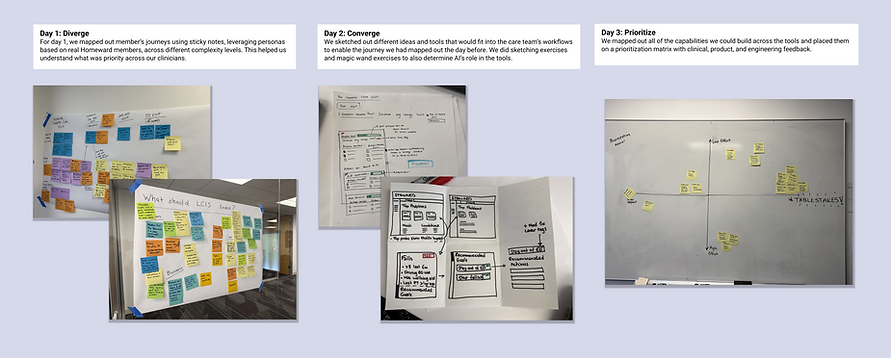
With problems defined, I ran a three-day workshop with stakeholders across clinical, product, engineering, and design — co-creating with the people who would use these tools most.
Activities:
-
Day 1 | Diverge : Mapped the member journey across multiple personas, focusing on key moments (hospital discharge, chronic condition support, ED visit) through the lens of care team visits and clinical needs, imagining ideal tools that would support our teams without constraints.
-
Day 2 | Converge: Narrowed focus to the staff experience, using guided activities to ensure tools aligned to existing workflows and how Homeward operates.
-
Day 3 | Prioritize: Used Figma Make to co-create lo-fi concepts with stakeholders in real time, then prioritized capabilities for build
Tool 1: AI Native Care Plans
Working with the clinical team, I designed goal-based care plans structured around the outcomes we sought to achieve for each member. Leveraging past medical history, the tool surfaces AI-suggested goals ranked by clinical impact, giving care teams a clear, prioritized starting point for each visit and ensuring actions carry forward across the care team without relying on memory.

Tool 2: Provider Visit Support Tools
With care plan actions defined, I prototyped concepts for bringing them into the native tools care teams use during visits. The solution embedded Steward directly within Athena, enabling care teams to start workflows, complete tasks, and document notes without switching tools before, during, and after a visit. This substantially reduced tool switching and surfaced the right information at the right time.

Output 3: Care Delivery Vision Blueprint
I created a service blueprint demonstrating how both tools work together within care team workflows — used to align cross-functional stakeholders and continue defining requirements for future capability expansion. The blueprint followed 1 member's journey and outlined the staff's actions, the tools that supported those actions, future state capabilities, and research insights.
Future Capabilities
-
Auto-Completing Workflows & Tasks: Leveraging our AI scribe to auto-complete tasks and reduce documentation duplication
-
Auto-Generating Tasks: Based on visit actions, automatically suggest the next best actions to continue progress toward member goals. Care team members can approve or reject this action.
-
Panel Management View: A dashboard giving care teams a prioritized, member-level view of progress across their full panel, reducing reliance on reviewing individual member profiles one at a time.

Blueprint snapshot

Full blueprint
My Learnings
Process
The biggest challenge wasn't the design, it was sequencing the work. Learning to identify the smallest viable version of the vision that would still generate meaningful feedback, and then building from there, was a skill I developed in real time. Equally important was change management. The workshops weren't just about co-creation, they were the beginning of building buy-in with our stakeholders. Tools that change day-to-day clinical workflows require dedicated training and reinforcement that extend well beyond launch. The more care teams felt ownership over what we were building, the smoother adoption became at launch.
Building AI Tools for Clinicians
Providers were excited about what these tools could do, but they were also wary. AI-suggested goals and auto-generated tasks raised a real concern: that clinical authority was being handed to an algorithm that they did not understand. What I learned is that trust doesn't come from the technology itself, it comes from how you position and build it. Every AI-generated suggestion was a starting point that a clinician could accept, modify, or ignore based on their own judgment and knowledge of the member. Making clear the role of AI in the process and where the boundaries were drawn led to greater adoption and trust of our teams.